Traditional
migration
Specialist teams drive the work,
often sequentially.


AI agents are changing how enterprise BI migrations are executed, moving the industry beyond people-led projects and conventional automation.
The migration objective has not changed. Understand the existing BI environment, determine what needs to move, rebuild it on the target platform, and prove that the result works.
What has changed is how much of that work can be handled by technology.
Specialist teams drive the work,
often sequentially.
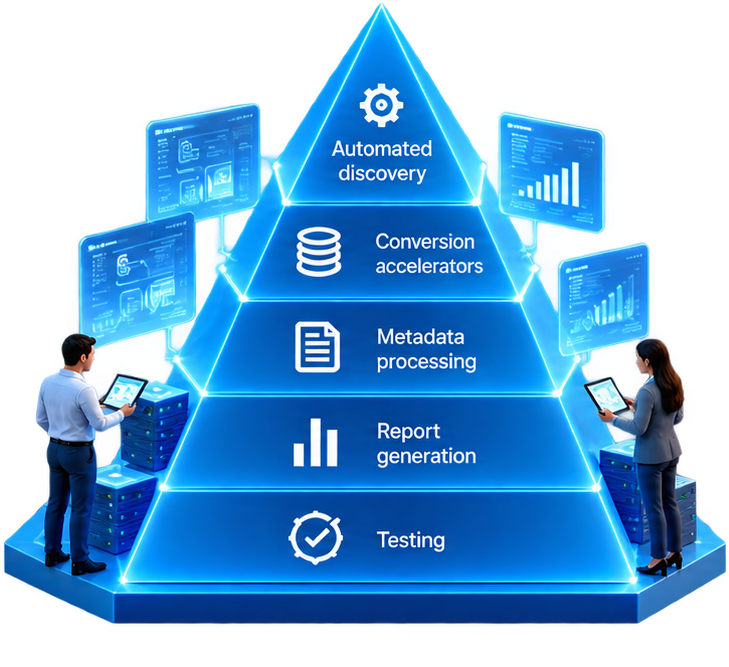
Repetitive work is automated, but people
still orchestrate the migration.
AI agents handle specialized workloads while
human experts provide oversight, judgment
and exception handling.
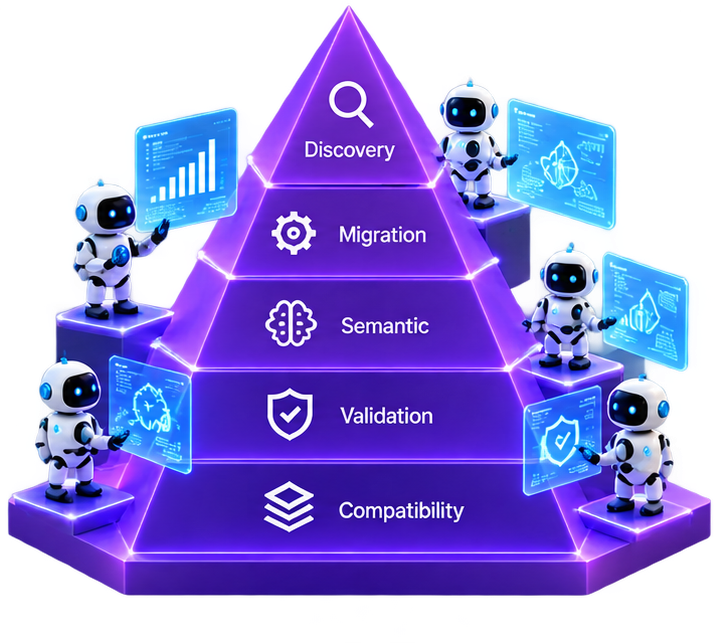
This progression is not simply from less automation to more automation. Work that once required people to execute and coordinate every stage can increasingly be distributed across specialized agents and run in parallel.
A BI migration is shaped by the platform being migrated from. Its metadata model, business logic, application architecture, proprietary objects and dependencies all influence what has to be discovered, rebuilt and validated. That is why a Cognos migration presents a different set of problems from MicroStrategy. Qlik is different from SAP BusinessObjects. Tableau is different again.
Modernize BI looks at those problems platform by platform.

Workbooks, calculations, data sources and extracts
Tableau migrations can involve more than moving workbooks. Calculations, embedded or published data sources, extracts, permissions and other workbook dependencies can all affect the migration and require validation.

Metadata, schema objects, reports, dossiers and dependencies
MicroStrategy migrations can involve complex relationships across metadata, schema objects, reports, dossiers, filters and prompts. Understanding those dependencies is critical to preserving the underlying business logic during migration.

Universes, reports, metadata and semantic dependencies
BusinessObjects migrations must account for the relationships between universes, reports, metadata and underlying data sources. Changes to the semantic layer can have implications across a large reporting environment.

Framework Manager models, packages, report logic and metadata
Cognos environments rely heavily on modeled metadata. Framework Manager models, packages and reports can contain interdependent structures and business logic that need to be understood before they can be rebuilt and validated.

Financial models, dimensions, business rules and dependencies
Hyperion environments often encode financial logic across multidimensional models, calculations, business rules and reporting dependencies. Preserving those relationships is central to a successful migration.

Report formulas, formatting, parameters and data connections
Crystal Reports can contain significant logic within individual reports, including formulas, parameters, formatting and data-source definitions. That makes migration highly dependent on understanding how each report is constructed.

Load scripts, associative models, applications and data connections
Qlik applications bring together load scripts, data connections, data models and application objects. Understanding how these components interact is essential when migrating the underlying applications and logic.

LookML models, explores, dimensions and business logic
Looker places much of its business logic in LookML. Models, explores, dimensions, measures and derived logic therefore become important elements to understand and reconstruct during migration.

Datasets, dataflows, cards and embedded business logic
Domo environments can distribute logic across datasets, dataflows, cards and calculations. Understanding how those assets connect is important to determining what needs to be migrated, rebuilt or revalidated.

Worksheets, models, answers and search-driven semantics
ThoughtSpot's search-driven experience depends on the relationships between underlying models, worksheets and the analytical definitions used to generate Answers and other content. Those semantic relationships need to be preserved during migration.
Modernize BI brings together reporting and perspectives on the platforms, technologies and approaches shaping BI modernization.
Deep dives into migration approaches, platform challenges, economics and emerging practices.
Developments across the BI and analytics landscape that matter to organizations planning their next move.
Conversations, explainers and platform-specific perspectives on BI migration and modernization.